Danger of a via Ferrata fall!
A via Ferrata fall can be more dangerous than a fall in sport climbing. This is mainly due to the fall factor, cushioning, and belay technique.
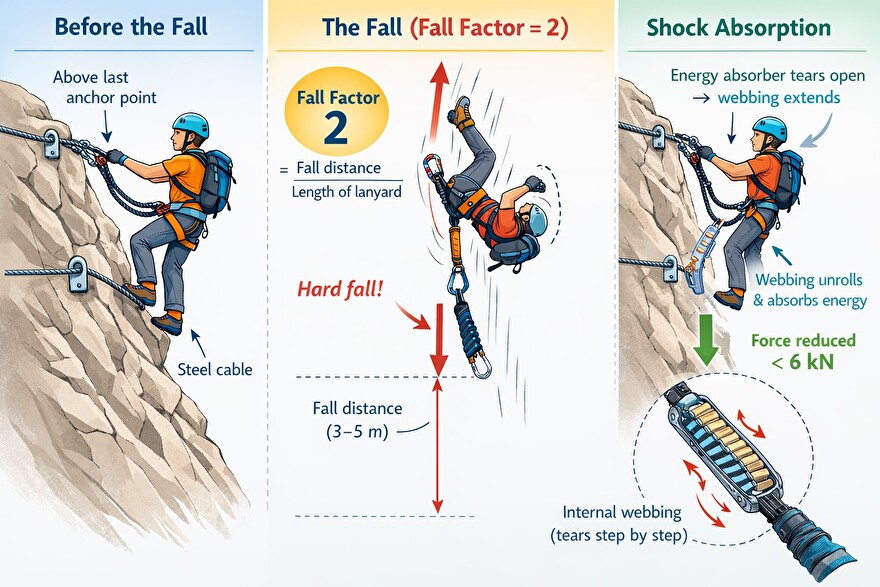
1. Very high fall factor
In via ferrata, you usually climb above the last anchor point of the steel cable.
If you fall:
- you first fall down to the previous anchor point,
- then the via ferrata set becomes taut.
This can cause the fall factor to be almost 2.
The fall factor is a term from Fall Factor and means: fall factor = fall distance / length of the system
In via ferrata:
- short arms of the set
- relatively long fall distance
Therefore, large forces. For comparison: in sport climbing, the fall factor is usually lower than 1.
2. No dynamic rope
In sport climbing, the energy of a fall is absorbed by a dynamic climbing rope, such as a Dynamic Climbing Rope.
That rope:
- sometimes stretches 30–40%
- gradually absorbs the fall.
On a via ferrata:
- there is no long dynamic rope
- only a short energy absorber in the set.
The energy absorbency is therefore much more limited.
3. Hard structures around
On a via ferrata, you are close to:
- rock
- iron steps
- ladders
- cable anchors
During a fall, you can therefore hit the wall or metal parts.
4. Possible fall distance
For example, if the anchor points are 3–5 meters apart:
- you climb above the anchor
- you fall to the previous anchor
- plus the length of the set
The total fall can be 5–8 meters before the energy absorber fully activates.
5. That's why three things are crucial on a via ferrata:
- a modern set according to EN 958
- always two carabiners on the cable
- never climb above an anchor point without being secured.
CanyonZone Knowledge base Via Ferrata / Klettersteig: Go Back.
CanyonZone
-
- Experts in canyoning & caving gear - ship worldwide
-
- Rent outdoor equipment
- New items in assortment
- Special offers
- Pre-ordering 2026
- NEW - Petzl Canyoning / Caving Line 2026
- 2nd hand canyoning caving articles
- Items / packages customer specific
- Giftcards of CanyonZone
-
- Canyoning (basic) equipment
- Canyoning equipment packages
- Luggage / Travel Bags
-
Canyoning Neoprene clothing
-
Size charts by Brand
- Aventure Verticale (AV) size charts jackets and pants
- Axe Aventure neoprene size charts
- CE4Y neoprene size charts
- GUARA neoprene size charts
- Sandiline Neoprene size chart
- Seland neoprene clothing size charts
- Newex neoprene size charts
- NRS neoprene size charts
- Vade Retro neoprene size charts
- Custom made neoprene wetsuit, required size data
- Change clothes after canyoning
- Canyoning Wetsuits
- Protective Canyoning Clothing
- Canyoning Neoprene Headgear
- Canyoning Drysuit / Undersuit
- Canyoning Neoprene shirts & shorts
- Canyoning Knee - elbow protectors / pads
- Canyoning Neoprene gloves
- Canyoning Neoprene socks
-
Size charts by Brand
- Canyoning shoes
- Harnesses & Accessories
- Helmets outdoor sports
- Carabiners & maillons
- Descend devices
- Ascending / Rise along rope
- Pulleys
- Rope & webbing slings
- Anchoring & accessories
- Via Ferrata / Klettersteig sets
- Outdoor Gloves / (ice-)canyoning, caving, via ferrata
- Canyoning Back Packs, bags & duffels
- Drybags & Kegs, Boats
- Outdoor Knives & Scissors
- Safety in outdoor sports
- First Aid / Medical Articles
- Rescue in outdoor sports
- Camping, Bivouac & Backpacking
- Winter- / Ice Canyoning
-
Canyoning Books & Topographic Maps
- Map Pouch
-
Canyoning Guide Books
- Australia
- Austria
- France (including Corsica and La Reunion)
- Germany
- Greece (including Crete) / Balkans
- India
- Israel
- Italy (including Sardinia)
- Jordan / Middle East
- Morocco
- New Zealand & Australia
- Portugal (including Madeira and Azores)
- Romania
- Scandinavia
- Slovenia
- Spain (including Canary Islands and Majorca)
- Turkey
- United Kingdom (UK) / Scotland
- United States of America
- South America
- Switzerland
- Canyoning Techniques & Skills
- Canyoning Maps
- Outdoor Children's Books
- Outdoor DVDs
- Via Ferrata / Klettersteig books
- Repair & Maintenance
- Miscellaneous items outdoor sports
-
- Especially for Ladies
- Especially for Children
- Especially for Instructors and Guides
- Especially for Outdoor Sports Companies
- Especially for Underwater / Cave diving / Diving
-
- Caving (basic) equipment
- Caving equipments packages
- Caving Suits / Overalls
- Caving Under Suits
- Caving Boots / Wellies
- Caving Socks
- Caving Knee- and Elbow Pads
- Caving Gloves
- Headlamps & torches
- Caving Bags & BackPacks
- Tents and Bivi bags
- Caving & Potholing Books and topographic maps
-
-
Climbing related gear: on request
-
- Services
-
- CanyonZone New(s)
- CanyonZone Customer Service
- Contact about Assortment
- Business ordering at CanyonZone
- About CanyonZone
- CanyonZone's FAQ
- CanyonZone's Knowledge Base
- About CanyonZone, owner Gertjan van Pelt
- Works together with
- Link exchange
-
- Privacy
- Terms and Conditions
-
Terms and Conditions Rental
-