How to patch small holes in your neoprene!
You have probably wondered at some point if you can repair those small holes that appear in your wetsuit over time. Those holes appear almost unnoticed. You are in a canyon wearing your fantastic wetsuit, a branch or a sharp stone crosses your path during the descent... and bam! A hole in your wetsuit. Sounds familiar? Fortunately, you can repair them, and it is best to do so immediately, because as soon as a hole appears in your wetsuit, no matter how small, it seems to take on a life of its own and grow exponentially. We always recommend repairing it as soon as possible – it really makes a world of difference.
WHY SHOULD YOU SEAL THE HOLES IN YOUR NEOPRENE?
The outer nylon layer protects the neoprene, the rubbery part. Unprotected neoprene is fragile and can easily be damaged, even by your fingernails, when putting it on, as is often the case with swimming wetsuits. That is why most wetsuits are double-layered, meaning they are lined with fabric on both sides. And in suits like those used for canyoning, the neoprene in wear-prone areas, such as the elbows and knees, may be laminated with Supratex. This is the type of neoprene that Reparacion Neoprene uses in their workshop to repair protective gear.
When the nylon lining of the neoprene gets punctured—when a small hole appears—the rubber becomes exposed. Through use, the rubber will wear down, causing the hole to enlarge, and after just a few uses, the damage can become significant. Sealing these holes is the way to prevent the initial minor damage from expanding into a hole that goes completely through the neoprene and lets water into your wetsuit. Water, cold... no!
In this tutorial, Reparacion Neoprene shows you how to glue small holes to make your neoprene wetsuit look perfect.
How to repair small holes in your neoprene suit
You will need the following: neoprene glue, a brush to apply the glue, a universal solvent, and an old cloth to clean the brush after use.
Do not use any glue other than one specifically designed for neoprene to ensure a good result.
STEPS TO GLUING YOUR NEOPRENE
1. PREPARATION
First, ensure your wetsuit is clean and dry for a good result. Inspect your wetsuit, look for small holes or damage, and simply repair them with a little neoprene glue so they do not get bigger. I know we keep repeating this, but it is really important. I assure you that your wetsuit will last longer if you perform this maintenance. Really!
2. APPLYING THE NEOPRENE GLUE
Apply the neoprene glue to the spot to be repaired using a brush. Start by applying a first layer, making sure not to go too far beyond the area to be repaired, and gradually fill the hole.
3. CONSECUTIVE LAYERS
For a good result, you must apply multiple layers of glue. Do not apply too much; you are probably familiar with the saying "haste makes waste!". Leave about half an hour between each layer to allow the neoprene to absorb the glue. You will see that the hole appears full after applying the glue, but the level will drop as the glue dries. Apply as many layers as necessary until the hole is completely filled.
4. DRYING
Wait 24 hours before using your wetsuit again; this is the time the glue needs to reach its maximum hardness.
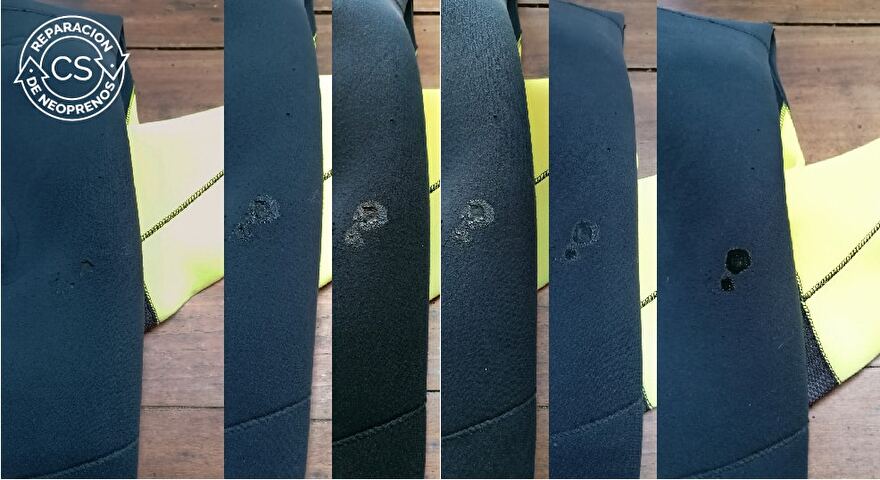
In the photo above, you can see the development of a hole until it is repaired and completely filled after applying multiple layers of neoprene glue.
Based on an article by www.reparaciondeneoprenos.es
Overview Canyoning knowledge base: Go back.
CanyonZone
-
- Experts in canyoning & caving gear - ship worldwide
-
- Rent outdoor equipment
- New items in assortment
- Special offers
- Pre-ordering 2026
- NEW - Petzl Canyoning / Caving Line 2026
- 2nd hand canyoning caving articles
- Items / packages customer specific
- Giftcards of CanyonZone
-
- Canyoning (basic) equipment
- Canyoning equipment packages
- Luggage / Travel Bags
-
Canyoning Neoprene clothing
-
Size charts by Brand
- Aventure Verticale (AV) size charts jackets and pants
- Axe Aventure neoprene size charts
- CE4Y neoprene size charts
- GUARA neoprene size charts
- Sandiline Neoprene size chart
- Seland neoprene clothing size charts
- Newex neoprene size charts
- NRS neoprene size charts
- Vade Retro neoprene size charts
- Custom made neoprene wetsuit, required size data
- Change clothes after canyoning
- Canyoning Wetsuits
- Protective Canyoning Clothing
- Canyoning Neoprene Headgear
- Canyoning Drysuit / Undersuit
- Canyoning Neoprene shirts & shorts
- Canyoning Knee - elbow protectors / pads
- Canyoning Neoprene gloves
- Canyoning Neoprene socks
-
Size charts by Brand
- Canyoning shoes
- Harnesses & Accessories
- Helmets outdoor sports
- Carabiners & maillons
- Descend devices
- Ascending / Rise along rope
- Pulleys
- Rope & webbing slings
- Anchoring & accessories
- Via Ferrata / Klettersteig sets
- Outdoor Gloves / (ice-)canyoning, caving, via ferrata
- Canyoning Back Packs, bags & duffels
- Drybags & Kegs, Boats
- Outdoor Knives & Scissors
- Safety in outdoor sports
- First Aid / Medical Articles
- Rescue in outdoor sports
- Camping, Bivouac & Backpacking
- Winter- / Ice Canyoning
-
Canyoning Books & Topographic Maps
- Map Pouch
-
Canyoning Guide Books
- Australia
- Austria
- France (including Corsica and La Reunion)
- Germany
- Greece (including Crete) / Balkans
- India
- Israel
- Italy (including Sardinia)
- Jordan / Middle East
- Morocco
- New Zealand & Australia
- Portugal (including Madeira and Azores)
- Romania
- Scandinavia
- Slovenia
- Spain (including Canary Islands and Majorca)
- Turkey
- United Kingdom (UK) / Scotland
- United States of America
- South America
- Switzerland
- Canyoning Techniques & Skills
- Canyoning Maps
- Outdoor Children's Books
- Outdoor DVDs
- Via Ferrata / Klettersteig books
- Repair & Maintenance
- Miscellaneous items outdoor sports
-
- Especially for Ladies
- Especially for Children
- Especially for Instructors and Guides
- Especially for Outdoor Sports Companies
- Especially for Underwater / Cave diving / Diving
-
- Caving (basic) equipment
- Caving equipments packages
- Caving Suits / Overalls
- Caving Under Suits
- Caving Boots / Wellies
- Caving Socks
- Caving Knee- and Elbow Pads
- Caving Gloves
- Headlamps & torches
- Caving Bags & BackPacks
- Tents and Bivi bags
- Caving & Potholing Books and topographic maps
-
-
Climbing related gear: on request
-
- Services
-
- CanyonZone New(s)
- CanyonZone Customer Service
- Contact about Assortment
- Business ordering at CanyonZone
- About CanyonZone
- CanyonZone's FAQ
- CanyonZone's Knowledge Base
- About CanyonZone, owner Gertjan van Pelt
- Works together with
- Link exchange
-
- Privacy
- Terms and Conditions
-
Terms and Conditions Rental
-